
The Claim
A rigorous examination of the geometry, physics and real-world behavior of off-centerline auxiliary rudder installations.
— Publicly circulated marketing statement"A number of years ago, various trials were conducted through the University of Southampton to help determine if off center installations affect performance. The tests were conclusive: The Hydrovane is absolutely indifferent as to its location – as long as it has 'clean water' to work with, the rudder can produce its certain amount of steering power wherever it is located.
More importantly, however, are the real-life experiences on the water. About 80% of Hydrovane installations in the past 20 years have been mounted off center, and we have hundreds of testimonials from happy customers.
The only advantages of an amidships installation might be the aesthetics (for some traditional boats) and perhaps more protection provided by the boat's keel."
The brand presents as a general conclusion that an off-center installation maintains its effectiveness, but in this statement it does not provide an independently auditable technical document or academic work presenting the vector analysis, equations, test conditions and quantitative results necessary to independently evaluate such a conclusion.
User experience and the number of installations constitute relevant operational observations. However, by themselves, they do not demonstrate that an off-centerline auxiliary rudder installation is geometrically equivalent to a centerline installation under all operating conditions.
Therefore, the technical question is not whether an off-center installation can work. Clearly, it can. The relevant question is whether the same steering geometry and the same effective steering force are maintained when the rudder is displaced from the centerline, especially when the heel angle, rudder immersion, flow conditions and direction of applied forces change.
This distinction is important when evaluating a technical claim related to the effects of installation geometry.
A Matter of Physics and Geometry
This statement is not supported by the available evidence.
Why?
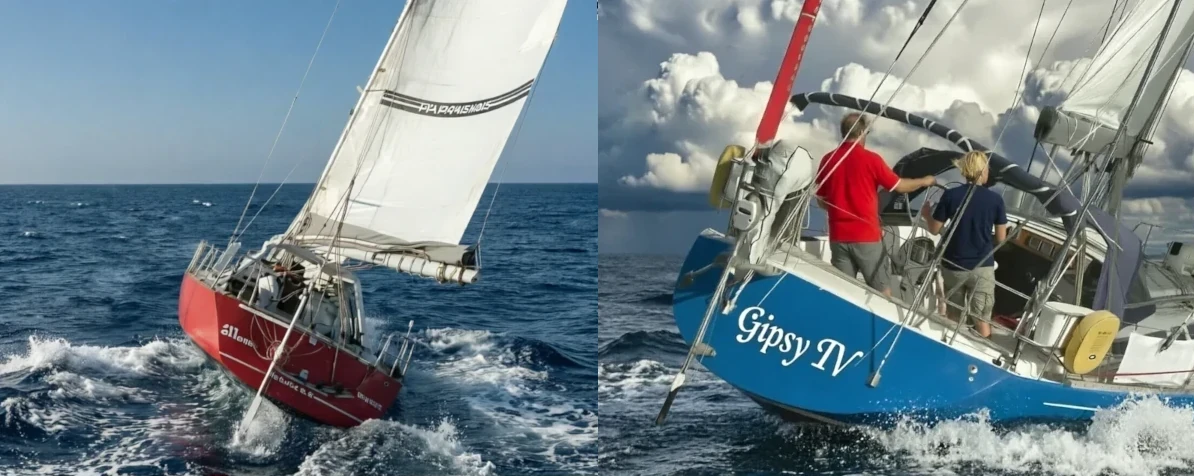
The principles of physics and basic geometry demonstrate that an off-center installation will produce a negative result. The larger the boat, the more pronounced the effect.
The Physics: What Really Happens When the Boat Heels
To calculate the height h relative to the horizontal — that is, how much of the rudder blade rises out of the water when the boat heels — the trigonometric sine function is used:
A concrete example
If you move the windvane 40 cm off the centerline and the boat heels 30°, you will lose 20 cm of rudder blade in the water.
Effective Surface Area: The Real Cost
If 20 cm of the blade comes out of the water, the effective surface area is reduced from the theoretical 30% of the auxiliary rudder blade to 24%.
If we move it 60 cm off the centerline, the result is that we will have lost approximately one third of the original surface area.
| Offset from centerline | Heel angle | Vertical loss (h) | Effective area | Loss vs. centerline |
|---|---|---|---|---|
| 0 cm (centerline) | 30° | 0 cm | 30% | — |
| 20 cm | 30° | 10 cm | 27% | −10% |
| 40 cm | 30° | 20 cm | 24% | −20% |
| 60 cm | 30° | 30 cm | 20% | −33% |
| 80 cm | 30° | 40 cm | 17% | −43% |
Why Total Blade Area Matters
In order to adapt auxiliary rudders to boats of greater length, manufacturers in the industry have had to increase the surface area of their rudder blades. That demonstrates that the total blade area matters.
Therefore, claiming or actively encouraging the installation of an auxiliary rudder off the centerline — regardless of the argument being used, whether it is some supposed university validation or the fact that thousands of users do it — is not consistent with the basic principles of physics and geometry.
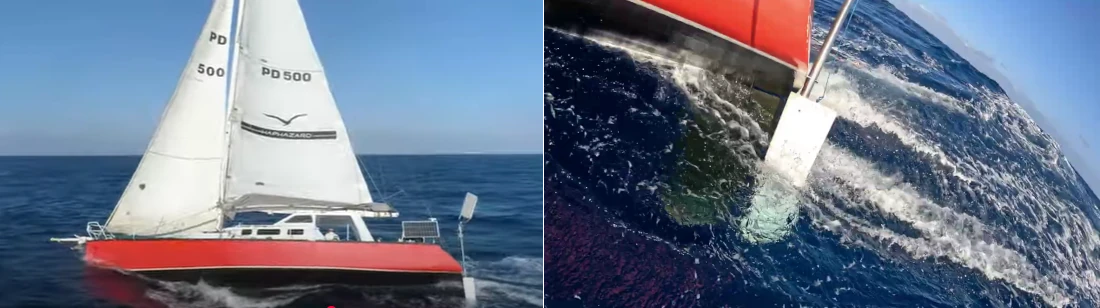
Key point: Physics and basic geometry demonstrate that the result will always be negative. In fact, the larger the boat, the worse the result will be.
Boat Size: Where the Limit Lies
Boats up to ~42 feet
On boats up to, say, 42 feet, you can move the windvane off the centerline — by up to around 30 cm — and partially compensate for the loss of performance by using a larger rudder blade.
This, of course, has a limit determined by the loads that the materials have to withstand.
South Atlantic offers three auxiliary rudder blade sizes precisely to address this reality: giving the installer the ability to recover lost area when a small offset is unavoidable.
Larger boats
But on a larger boat, this is simply no longer a viable solution.
Unless you accept that, with the regular rudder, the system will only work properly when the boat heels toward one of the two sides.
And that, obviously, is not acceptable.
Technical basis of the analysis
The conclusions presented in this analysis are based on fundamental principles of physics and geometry, together with the results of relevant technical and academic studies on the forces acting on rudders, hydrodynamic behavior, heel effects and the geometry of steering systems.
These studies do not necessarily investigate Hydrovane specifically nor auxiliary rudders installed off the centerline. Their relevance lies in the fact that they independently establish principles related to the behavior of submerged control surfaces and the hydrodynamic forces acting on them.
When these principles are applied to an auxiliary rudder installed off the centerline, the installation geometry becomes technically relevant. The lateral displacement of the rudder introduces an additional geometric variable that interacts with the boat's heel, rudder immersion, water flow and the direction of hydrodynamic forces.
Therefore, the purpose of this analysis is not to question whether an off-center installation can work. Real-world experience clearly shows that it can.
The technical question is more specific:
Does displacing an auxiliary rudder off the centerline preserve unchanged the steering geometry and effective steering forces under all sailing conditions?
In light of the physical and geometric principles analyzed below, this equivalence cannot simply be taken for granted. The following studies and technical references provide the scientific basis for this analysis.
Install on the centerline. Preserve the full effective area of your auxiliary rudder. Preserve your steering authority when you need it most.
Technical Resources & Bibliography
Technical documentation covers the following references:
-
Polytechnic University of Madrid (ETSIN), Department of Naval Architecture.
Zamora-Rodríguez, Izquierdo-Yerón and Botia Vera conducted experimental tests in a 100 m towing tank, complemented by CFD (Computational Fluid Dynamics) simulations, to investigate how vessel heel affects rudder hydrodynamic performance. The study demonstrates that the lateral force generated by a rudder varies significantly with the vessel's heel angle: it increases when the rudder is on the windward side and decreases when it is on the leeward side. The results also show that the rudder's degree of immersion and its orientation relative to the incoming flow are critical factors governing the steering force it can generate.
-
TU Delft (Netherlands) — the most established research group in the field
Keuning, Vermeulen, Katgert and others, from the Ship Hydromechanics Laboratory at Delft, have a specific line of research on this subject, with two relevant papers:
"The Yaw Balance of Sailing Yachts Upright and Heeled" — uses data from the DSYHS (Delft Systematic Yacht Hull Series) and the DSKS (Delft Systematic Keel Series), systematic series of tests involving different hulls, keels and rudders, both upright and heeled. • "Optimization of Upwind Sailing Applying a Canting Rudder Device" — tests conducted at the Delft laboratory using a 1992 America's Cup model, measuring rudder force separately under upright and heeled conditions. Delft is probably the world's most widely cited academic center for sailing yacht hydrodynamics. Its systematic series (DSYHS) have been a standard reference in sailing yacht design since the 1970s.
-
Australian Maritime College
"The Effect of Heel Angle and Free-Surface Proximity on the Performance and Strut Wake of a Moth Sailing Dinghy Rudder T-Foil" — experimental tests conducted in the towing tank at the Australian Maritime College. This is the most directly relevant study of all: it explicitly measures how heel angle and proximity to the free surface — that is, how close the rudder blade is to the air — affect rudder lift and drag, while varying immersion depth, angle and speed.
-
Naval Surface Warfare Center (Carderock), USA
A paper presented at the 18th Chesapeake Sailing Yacht Symposium (2007) describes tests in which sailing yacht rudders were instrumented with strain gauges and tested in a towing tank at different speeds, heel angles, and wave conditions. The study explicitly documents the case in which, at approximately 15° of heel, the upper part of the rudder reaches the free surface — in other words, it experimentally examines precisely the phenomenon in question: what happens to the rudder blade as heel brings it closer to emerging from the water.
-
University of Duisburg-Essen (UDE), Germany, in collaboration with the Federal
Waterways Engineering and Research Institute (BAW) and the Development Center for Ship Technology
and Transport Systems (DST).
Numerical and Experimental Investigation of Rudder-Induced Hydrodynamic Forces
- Approach:
- Experimental investigation in a towing tank combined with CFD simulations to measure lateral forces, hinge moments, and pressure distributions at high angles of attack.
- Key contribution:
- Fundamental to understanding the behavior of a primary or auxiliary rudder when a vessel undergoes severe yawing and extreme maneuvering conditions, such as broaching — a critical situation encountered particularly in lightweight performance sailing yachts and ocean-going sailing vessels.
-
ENSTA Bretagne / GSea Design (France),
- INNOV'SAIL 2017 paper (4th International Conference on Innovation in High-Performance Sailing Yachts, Lorient), signed by researchers from ENSTA Bretagne (doctors from École Centrale Lyon, University of Nantes, ENS Cachan) and GSea Design — the consultancy that designed the appendages of the flying catamarans of Oracle Team USA, Artemis Racing and Groupama in the America's Cup. The paper confirms as an established design principle that the height of the appendage relative to the free water surface is a critical parameter that modifies the load distribution, and that avoiding ventilation (air entry, which collapses hydrodynamic lift) is the objective pursued by naval architects and performance analysts to maximize appendage efficiency.
-
Technical University of Denmark (Danmarks Tekniske Universitet – DTU),
Department of Mechanical Engineering.
Core research team:
- Stig Staghøj Knudsen — Principal researcher and author of the PhD thesis.
- Jens Honoré Walther — Professor and principal project supervisor.
-
Technical University of Denmark (DTU)
Dynamic Fluid-Structure Interaction (FSI) of Racing Sailboats
- Approach:
- Developed at DTU, this work applies fluid-structure interaction models incorporating flexible hulls, keels, rudders, and foils operating in waves.
- Key contribution:
- Demonstrates how rudder blade flex under extreme loading conditions alters the effective angle of attack and overall drag. In high-performance sailing yachts, the torsional stiffness of the rudder blade helps prevent cavitation and loss of steering control (stall).
Explore South Atlantic Auxiliary Rudders
Three blade sizes. Centerline-first engineering. Built for bluewater sailors who understand that steering authority is not optional.
Visit the Online Store